Phase diagram of the Bose-Hubbard chain
The Bose-Hubbard model is the paradigmatic lattice model for strongly-correlated bosons. On a one-dimensional chain with $N$ sites and periodic boundary conditions, it reads
\[H = -t \sum_{i=1}^{N} \left( b_i^\dagger b_{i+1} + \mathrm{h.c.} \right) + \frac{U}{2} \sum_{i=1}^{N} \hat{n}_i(\hat{n}_i - 1) - \mu \sum_{i=1}^{N} \hat{n}_i\,,\]
where $b_i^\dagger$ ($b_i$) creates (annihilates) a boson on site $i$, $\hat{n}_i = b_i^\dagger b_i$ is the local number operator, $t$ is the hopping amplitude, $U$ is the on-site repulsion, and $\mu$ is the chemical potential. Competition between kinetic energy ($t$) and interaction energy ($U$) drives a quantum phase transition between a gapped Mott insulator at integer filling and a gapless superfluid. The phase boundary in the $(t/U, \mu/U)$ plane forms characteristic lobes, one for each integer occupation $n_0$.
In this example we map out the first Mott lobe ($n_0 = 1$) using two approaches: an analytic mean-field approximation and finite-size exact diagonalization (ED) using a particle-number-conserved basis built with SymBasis.jl.
Boundaries from the third-order perturbation theory
Within the third-order strong-coupling expansion around the atomic limit ($t/U \to 0$)[Freericks_1994], the upper and lower boundaries of the $n_0$-th Mott lobe are given by
\[\mu_+/U = 1 - 2 (n_0 + 1) \tilde{t} + n_0^2 \tilde{t}^2 + n_0 (n_0 + 1) (n_0 + 2) \tilde{t}^3\,,\]
and
\[\mu_-/U = 2 n_0 \tilde{t} - (n_0 + 1)^2 \tilde{t}^2 + n_0 (n_0 + 1) (n_0 - 1) \tilde{t}^3\,,\]
where $\tilde{t} = t/U$ is the dimensionless hopping strength. These expressions are obtained by computing the energy cost of adding or removing a particle from the Mott state, treating the hopping term as a perturbation.
U = 1.0 # on-site interaction strength

function per_th_μₛ(n₀, t, U)
    tilde_t = t / U
    return begin
        1-2 * (n₀ + 1) * tilde_t + n₀^2 * tilde_t^2 + n₀ * (n₀ + 1) * (n₀ + 2) * tilde_t^3,
        2 * n₀ * tilde_t - (n₀ + 1)^2 * tilde_t^2 + n₀ * (n₀ + 1) * (n₀ - 1) * tilde_t^3
    end
end

pt_tₛ = range(0.0; stop=0.215, length=100)
pt_μₛ = per_th_μₛ.(1 |> Ref, pt_tₛ, U |> Ref)
pt_μ_plusₛ = pt_μₛ .|> first
pt_μ_minusₛ = pt_μₛ .|> last
100-element Vector{Float64}:
0.0
0.004324568921538619
0.008611406999285788
0.012860514233241506
0.017071890623405774
0.021245536169778596
0.025381450872359965
0.029479634731149885
0.033540087746148355
0.037562809917355375
⋮
0.23902796653402714
0.23991902867054382
0.24077235996326904
0.24158796041220285
0.24236583001734516
0.24310596877869606
0.2438083766962555
0.24447305377002346
0.2451Boundaries from exact diagonalization
The ED estimate of the phase boundary is obtained from the finite-size excitation gap. The upper boundary of the $n_0 = 1$ Mott lobe is the energy cost of adding one particle to the $n_0 = 1$ ground state,
\[\mu_+ = E_0(N, N+1) - E_0(N, N)\,,\]
and the lower boundary is the energy cost of removing one particle,
\[\mu_- = E_0(N, N) - E_0(N, N-1)\,,\]
where $E_0(N, n)$ denotes the ground-state energy of the system with $N$ sites and $n$ particles. As the system approaches the superfluid phase these gaps close and the lobe shrinks. We compute these quantities for several system sizes to observe the finite-size convergence toward the thermodynamic limit.
Nₛ = 4:6; # total number of sites for which to compute the phase diagram
tₛ = 0.0:0.1:0.3; # hopping strength range for which to compute the phase diagram0.0:0.1:0.3Defining the DoF-object and particle-number-conserved basis
For bosons with a local Hilbert space of dimension $n_\mathrm{max} + 1$ (occupation numbers $0, 1, \ldots, n_\mathrm{max}$), SymBasis provides the predefined Boson DoF-object. We construct the basis by combining three symmetry groups: particle-number conservation TotalBosonicNumber to select states with a fixed particle number $n$, translational symmetry Translational to reduce the Hilbert space by fixing the quantum momentum number $k$, and spatial reflection symmetry SpatialReflection to include spatial parity sectors with the parity numbers $p = \pm 1$. These symmetries are composed to form the combined symmetry group, and we build the symmetry-resolved basis and assemble the Hamiltonian in each sector $(N, n, k, p)$ for $n \in \{N-1, N, N+1\}$, sweeping over both system sizes and hopping values.
using SymBasis
using LinearAlgebra, SparseArrays, Arpack

# initialize array to store ground state energies for each (t, N, n_particles)
evalₛ = fill(Inf, length(tₛ), length(Nₛ), 3)

# parameters for DoF object
n_max = 3  # maximum occupation number per site

# loop over the parameter space and compute ground state energies
for (id_t, t) in enumerate(tₛ)
    for (id_N, N) in enumerate(Nₛ)
        for (id_n, n_particles) in enumerate((N-1):(N+1))

            # consider all translation and parity quantum numbers
            k_values = (N % 2 == 0) ? [0, Int(N // 2)] : [0]
            p_values = [-1, 1]

            for k in k_values, p in p_values
                # construct the symmetry-resolved basis
                dofo = dof_object(Boson(n_max))
                pn_sg = sym(TotalBosonicNumber(n_particles, N), dofo)
                T_sg = sym(Translational(k, mod1.((1:N) .+ 1, N)), dofo)
                P_sg = sym(SpatialReflection(p, mod1.(N .- (1:N) .+ 1, N)), dofo)
                csg = pn_sg ∘ T_sg ∘ P_sg
                ba = basis(dofo, N, csg)

                hilbert_dim = length(ba.states)

                # initialize vectors to store the row indices, column indices, and values
                I_vec = Int64[]
                J_vec = Int64[]
                V_vec = ComplexF64[]

                b = Dict(ba.states .=> 1:hilbert_dim)
                for sₙ in ba.states
                    n = b[sₙ]
                    Nₙ = ba.norms[n]

                    # diagonal interaction term
                    for xᵢ in 1:N
                        n_xᵢ = read(sₙ, xᵢ)
                        if n_xᵢ > 0
                            push!(I_vec, n)
                            push!(J_vec, n)
                            push!(V_vec, 0.5 * U * n_xᵢ * (n_xᵢ - 1))
                        end
                    end

                    # off-diagonal hopping terms
                    for xᵢ in 1:N
                        xᵢ₊₁ = mod1(xᵢ + 1, N)

                        # annihilate at xᵢ₊₁, create at xᵢ
                        if read(sₙ, xᵢ₊₁) > 0
                            temp_s₁ = dec(sₙ, xᵢ₊₁)
                            temp_s₁ = inc(temp_s₁, xᵢ)
                            rep_s₁, rep_fac₁ = representative(temp_s₁, ba)

                            if haskey(b, rep_s₁)
                                m = b[rep_s₁]
                                Nₘ = ba.norms[m]
                                all_fac = -t * sqrt(Nₘ / Nₙ) * rep_fac₁
                                push!(I_vec, m)
                                push!(J_vec, n)
                                push!(V_vec, all_fac)
                            end
                        end

                        # annihilate at xᵢ, create at xᵢ₊₁
                        if read(sₙ, xᵢ) > 0
                            temp_s₂ = dec(sₙ, xᵢ)
                            temp_s₂ = inc(temp_s₂, xᵢ₊₁)
                            rep_s₂, rep_fac₂ = representative(temp_s₂, ba)

                            if haskey(b, rep_s₂)
                                m = b[rep_s₂]
                                Nₘ = ba.norms[m]
                                all_fac = -t * sqrt(Nₘ / Nₙ) * rep_fac₂
                                push!(I_vec, m)
                                push!(J_vec, n)
                                push!(V_vec, all_fac)
                            end
                        end
                    end
                end

                # construct and symmetrize the sparse Hamiltonian matrix
                h = sparse(I_vec, J_vec, V_vec, hilbert_dim, hilbert_dim)
                h .+= h'
                h ./= 2

                # compute ground state energy
                gs_energy = begin
                    try
                        eigs(h, nev=1, which=:SR) |> first |> first |> real
                    catch
                        eigvals(h |> collect) |> first |> real
                    end
                end

                # store the minimum ground state energy across all symmetry sectors
                if gs_energy < evalₛ[id_t, id_N, id_n]
                    evalₛ[id_t, id_N, id_n] = gs_energy
                end
            end
        end
    end
end
Extracting the phase boundaries
The upper and lower chemical-potential boundaries of the first Mott lobe are obtained from the ground-state energies in the three sectors $n \in \{N-1, N, N+1\}$:
ed_μ_plusₛ = (evalₛ[:, :, 3] .- evalₛ[:, :, 2]) ./ U
ed_μ_minusₛ = (evalₛ[:, :, 2] .- evalₛ[:, :, 1]) ./ U
4×3 Matrix{Float64}:
6.47543e-16 1.77859e-17 1.28473e-15
0.173279 0.176535 0.177618
0.26079 0.279084 0.28957
0.268655 0.297345 0.31611Plotting the phase diagram
using CairoMakie

fig = Figure()
ax = Axis(fig[1, 1]; xlabel=L"t/U", ylabel=L"\mu/U")
for (id_N, N) in enumerate(Nₛ)
    scatterlines!(ax, tₛ ./ U, ed_μ_plusₛ[:, id_N]; color=Cycled(id_N), label=L"N=%$(N)")
    scatterlines!(ax, tₛ ./ U, ed_μ_minusₛ[:, id_N]; color=Cycled(id_N))
end

lines!(ax, pt_tₛ ./ U, pt_μ_plusₛ; color=:black, linestyle=:dash, label=L"\text{3rd order perturbation theory}")
lines!(ax, pt_tₛ ./ U, pt_μ_minusₛ; color=:black, linestyle=:dash)

axislegend(ax; position=:rt, merge=true)
fig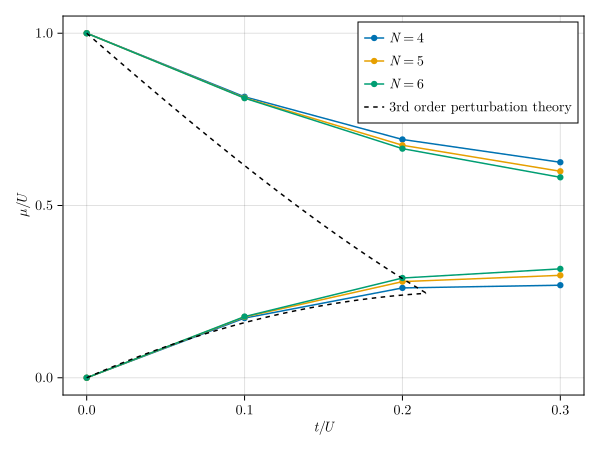
- Freericks_1994J. K. Freericks and H. Monien, Phase diagram of the Bose-Hubbard Model, Europhys. Lett. 26, 545 (1994).